

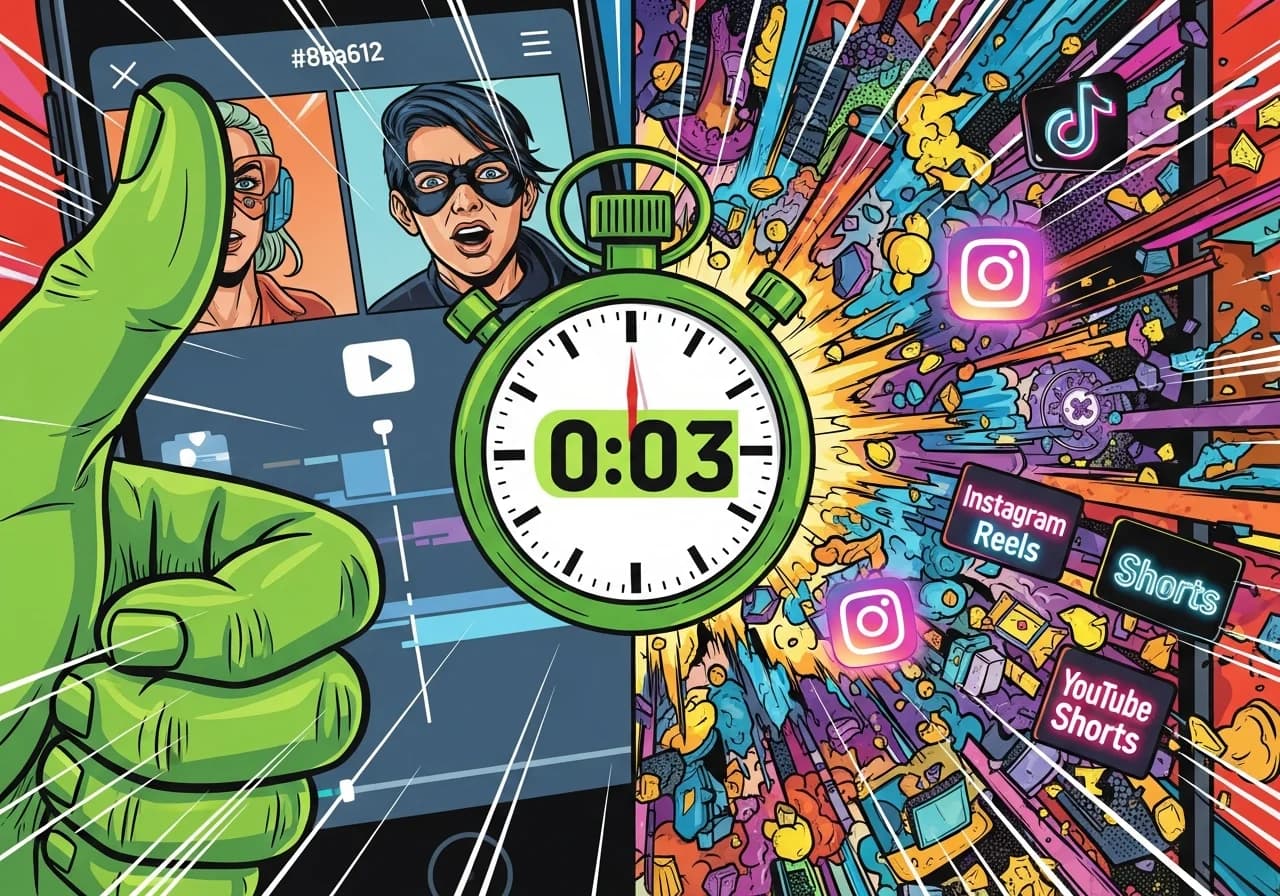
Hooks & Pattern Interrupts: How To Nail The First 3 Seconds (2026 Guide for Viral Shorts)
A hook is the opening line, visual, or sound in your video that stops viewers from scrolling and makes them watch, and it's the single most important element determining whether your content goes viral or dies in obscurity.
Table of Contents
- Why 3 Seconds Now Controls The Algorithm
- 6 Hook Formulas That Drive Virality
- Pattern Interrupts That Break The Scroll
- Platform-Specific Hook Strategies
- How AI Is Transforming Hook Creation
- 10 Plug-and-Play Hooks You Can Steal
Why 3 Seconds Now Controls The Algorithm
Here's the brutal truth: 71% of viewers decide within the first 3 seconds whether to watch or scroll. According to Stack Influence's 2025 algorithm analysis, the average viewer makes their decision in just 1.7 seconds. That's not a typo. Less than two seconds to prove you're worth their time.
The "3-second rule" has evolved from best practice to algorithmic imperative. TikTok's 2025 algorithm updates introduced a 3-second skip threshold. If users scroll past within 3 seconds, your ranking tanks significantly. Instagram's internal AI now predicts how likely you are to spend more than 10 seconds on a post within the first moments of viewing.
The numbers tell a stark story. As documented by TapNex's short-form video guide, videos that nail the 3-second mark see 65% longer average watch times and 41% higher completion rates. Meanwhile, videos failing to hook viewers experience 60% lower overall engagement on Instagram.
Cameron Gidari, VP of Social Media at Major League Baseball, reframed the conventional wisdom perfectly: "People say that Gen Z has a short attention span on social media. They don't. They have a short consideration span. Gen Z will watch a five minute video if it's good, but they'll skip right past it if the first three seconds don't give them a reason to stay."
This is exactly why mastering hooks matters so much, as we cover in our complete guide on How To Make Viral AI Videos in 2026. The hook earns the right to their attention; the content must then deserve it.
6 Hook Formulas That Drive Virality
Analysis of millions of viral videos reveals six core hook frameworks that consistently outperform generic openings. These aren't theories. They're patterns extracted from content that actually went viral across TikTok, Instagram Reels, and YouTube Shorts in 2025.
The Curiosity Gap Hook
Curiosity gap hooks create psychological tension viewers must resolve by watching. Your brain literally cannot rest until it closes the information gap. According to LYFE Marketing's viral hook research, these consistently rank among the highest-performing opener types.
Templates that work: "Only 1% of people know this about [topic]..." or "I probably shouldn't share this, but..." or "The thing nobody tells you about [topic] is..."
Devin Jatho, one of TikTok's top creators, specifically emphasizes the use of negation combined with hard truth and funny hooks as his signature approach. The negation creates the gap. The truth fills it.
The Contrarian Hook
Contrarian hooks challenge assumptions and create urgency. They signal valuable counterintuitive information that viewers can't find elsewhere. As noted by HeyOrca's hook analysis, these perform especially well in educational content but require genuine contrarian insights to avoid audience backlash.
Templates that work: "Everything you knew about [topic] is 100% WRONG!" or "Stop doing [common thing]. Do this instead." or "[Popular advice] is actually terrible advice. Here's why."
The key is delivering on the promise. Misleading contrarian hooks create short-term gains but long-term penalties as TikTok's algorithm now tracks drop-offs from payoff mismatches.
The Call-Out Hook
Call-out hooks directly target specific viewer segments, achieving 40% higher retention by filtering for highly relevant audiences who self-select to watch. According to Sendible's video hook research, specificity is the secret weapon here.
Templates that work: "If you're a [target audience], stop scrolling!" or "This is for everyone who [specific situation]..." or "POV: You're a [specific person] and [relatable situation]."
The more specific your call-out, the more powerfully it resonates with your actual target audience. Generic call-outs like "everyone needs to see this" paradoxically reach no one.
The Problem-Solution Hook
These hooks address pain points directly and promise quick resolution. Usevisuals' scroll-stopping hook analysis shows these dominate in how-to and tutorial content.
Templates that work: "Struggling with [pain point]? Here's how to fix it in 60 seconds." or "The [problem] hack that changed everything for me." or "I wasted [time/money] until I learned this [topic] trick."
The Story Hook
Story hooks open narrative loops that viewers must close by watching. Humans are hardwired for narrative completion.
Templates that work: "I tried [X] for 30 days, here's what happened..." or "This is the story of how [unexpected outcome]..." or "Something weird happened when I [action]..."
The Social Proof Hook
These leverage credibility and results to grab attention instantly.
Templates that work: "[Number] people have tried this and [result]." or "This is why [authority figure] does [action]." or "I asked [number] experts about [topic]. They all said this."
If you want to skip the trial-and-error process of testing hooks manually, platforms like Reshort include these formulas built directly into their AI video script generator. You pick a format like documentary, tutorial, UGC, or horror, and the hook is already baked in based on what's currently working.
Pattern Interrupts That Break The Scroll
A pattern interrupt is a psychological trigger that breaks expected behavior and forces attention. According to Submagic's 2025 hook research, pattern interrupts increase watch time by up to 85% and conversion rates by 32% when executed correctly.
Top creators now layer multiple interrupt types in what's called the "holy grail" approach: combining visual, verbal, and audio hooks simultaneously in the first 1.5 seconds.
Visual Pattern Interrupts
Visual interrupts exploit the brain's automatic attention response to unexpected movement and color. The "visual jolt" in the first 1.5 seconds, such as a frame rate manipulation from normal speed to slow motion, immediately captures attention.
Techniques that work: rapid color shifts from monochrome to vibrant, unexpected movement entering frame, dramatic zooms or camera whips, visual glitch effects, and face reveals. Data from Torro Media's viral content study shows videos featuring a face in the first 3 seconds see 35% higher retention, while starting with humor, a call-to-action, and motion delivers 38% higher hook rates.
Audio Pattern Interrupts
Audio interrupts exploit TikTok's unique context: 95% of TikTok videos are watched with sound on, versus 85% muted on Facebook. This makes audio hooks disproportionately powerful on TikTok specifically.
Techniques that work: sudden sound effects, genre shifts in music, voice modulation from whisper to shout, trending audio in the first 3 seconds. According to Napolify's algorithm analysis, trending audio boosts retention by 41%. However, TikTok's November 2025 update deprioritizes overused audio, meaning new and original sounds now outperform trend-chasing.
Text-Based Pattern Interrupts
Text interrupts remain critical for the 85% watching without sound on platforms other than TikTok. SendShort's engagement research found videos with captions achieve 38% longer viewer retention and 65% vs 37% completion rates.
Techniques that work: bold text that punches onto screen, animated typography matching speech cadence, strategically timed reveals where text appears word-by-word, and contrasting colors that pop against video background. These techniques increase retention by 25%.
For faceless content creators, these visual and text-based interrupts become even more critical, as we explore in our guide on faceless storytelling AI videos. When there's no face to connect with, the pattern interrupt carries the entire weight of stopping the scroll.
Platform-Specific Hook Strategies
Each platform now has distinct algorithmic priorities that demand tailored approaches. What works on TikTok may flop on YouTube Shorts, and vice versa.
TikTok Hook Strategy (2026)
TikTok's 2025 updates fundamentally changed hook requirements. According to Sotrender's algorithm analysis, the September 2025 update made originality the primary ranking factor, sharply penalizing reposts and remixes. January's update penalizes cross-posted content by up to 40% in reach.
The algorithm now monitors a 15-20 second engagement threshold beyond the initial 3-second hook, meaning you can't just frontload all value. You need to maintain engagement throughout. Keywords must appear in three places simultaneously: hook text on screen, voiceover, and caption.
For TikTok specifically, Napolify's June 2025 analysis confirms that new, original sounds now outperform trend-chasing. The platform is actively suppressing overused audio.
YouTube Shorts Hook Strategy (2026)
YouTube Shorts implemented a major view counting change on March 31, 2025. According to Digital Music News reporting, any playback or replay now counts as a view, where previously it required minimum watch time. However, YouTube preserved "Engaged Views" for monetization calculations.
Unlike TikTok's rapid viral cycles, Shorts can go viral weeks or months later through extended testing. Hootsuite's YouTube algorithm guide shows the algorithm heavily favors loopable content, videos where the ending leads smoothly back to the beginning, encouraging replays. This means your hook should set up a loop, not just grab attention.
YouTube Shorts maintain an impressive 73% average retention rate compared to 52% for long-form YouTube, with 80% of engagement happening within the first 10 seconds. The sweet spot is 50-60 seconds, where viral videos achieve 76% average watch retention.
Instagram Reels Hook Strategy (2026)
Instagram revealed its ranking hierarchy in January 2025. According to Stack Influence's Reels analysis, watch time is the #1 factor, followed by likes per reach for existing followers, and sends per reach (DM shares) as the most powerful signal for reaching new audiences.
Adam Mosseri confirmed that content must meet five criteria for recommendation eligibility: no watermarks from other platforms, include audio, under 3 minutes, original content, and good account standing.
Instagram Reels demand brevity more than other platforms. Videos 7-15 seconds achieve 74% completion, 15-30 seconds drops to 57-74%, and anything over 60 seconds struggles at 36% completion. Your hook needs to promise value that can be delivered in under 30 seconds.
If you're creating content for multiple platforms, understanding these differences is crucial. Our guide on the best visual styles for AI videos in 2026 breaks down what works where.
How AI Is Transforming Hook Creation
AI has become embedded in short-form content creation, with 86% of global creators now using generative AI tools according to Adobe's October 2025 report of 16,000 creators. The shift is driven by measurable performance gains.
According to Bynder's AI vs human content study, AI-assisted posts show 21.8% higher median engagement rates overall, with TikTok specifically seeing a 47% increase for AI-assisted content. That's not a marginal improvement. That's nearly half again as much engagement.
TikTok's own newsroom announced AI Outline in October 2025, generating video titles, hashtags, hooks, and outlines from prompts. The platform is actively encouraging AI-assisted creation.
Dedicated hook generators have proliferated throughout 2025. Some report users achieving 600% increases in video engagement through AI-generated hooks. Others offer "virality scores" predicting hook effectiveness before you even publish.
However, authenticity concerns persist. Research shows 52% of consumers report reduced engagement when they suspect content is AI-generated, while 26% find it impersonal. The consensus recommendation: keep AI contribution below 30% of final content and maintain human oversight for voice and fact-checking.
This is where purpose-built platforms shine. Reshort offers a free AI video script generator with built-in hooks across formats like documentary, UGC, horror, true crime, tutorial, listicle, and POV styles. The hooks are already optimized based on what's currently trending, so you're not starting from scratch or guessing what might work.
The key difference from generic AI tools is that these specialized platforms constantly update their formulas based on real performance data. When a new hook style starts trending, it gets incorporated. When something stops working, it gets phased out. You get the benefits of AI speed without having to become an algorithm expert yourself.
For more on using AI to create viral content, check out our comparison of AI TikTok video script generators.
10 Plug-and-Play Hooks You Can Steal
Here are 10 hooks you can adapt to your niche today, based on the formulas that consistently drive virality across platforms:
Curiosity Gap Hooks:
- "The [topic] secret that [authority figures] don't want you to know..."
- "I tested [popular thing] for [time period]. The results shocked me."
- "Why does nobody talk about this [topic] hack?"
Contrarian Hooks: 4. "Stop [common advice]. It's actually hurting your [result]." 5. "[Popular belief] is a lie. Here's the truth."
Call-Out Hooks: 6. "If you're still [common mistake], this is your sign to stop." 7. "This is for the [specific audience] who [relatable struggle]."
Problem-Solution Hooks: 8. "The [time] [topic] fix that actually works." 9. "How I went from [bad state] to [good state] in [timeframe]."
Social Proof Hooks: 10. "[Number/Authority] revealed their [topic] secret. Here it is."
Each of these can be combined with visual and audio pattern interrupts for maximum impact. Start with the hook text appearing on screen in the first 0.5 seconds, have your verbal hook hit by second 1.5, and include a visual jolt like a zoom, movement, or face reveal within the first 2 seconds.
Headline Overlay Formulas
Beyond the verbal hook, your text overlay needs to work independently for silent viewers. Here are formulas that spike retention:
The Number Formula: "[Number] [things] that will [benefit/change] your [topic]" — Numbers stop the scroll because they promise structured, digestible content.
The Warning Formula: "Don't [action] until you see this" — Creates urgency and fear of missing out.
The Secret Formula: "The [topic] secret [group] uses" — Implies insider knowledge worth watching for.
The Mistake Formula: "The #1 [topic] mistake (and how to fix it)" — Everyone wants to know if they're doing something wrong.
The Time Formula: "[Timeframe] to [result]" — Promises quick value delivery.
If you're looking to streamline this process, UGC AI videos can combine hooks with authentic-feeling content that converts.
Common Hook Mistakes That Kill Retention
Before you publish, avoid these retention killers that the data consistently reveals:
Generic openings provide no value proposition. "Check this out!" or "Watch until the end!" fail to spark curiosity. If a hook could apply to any video, it's not specific enough. According to Rally.Fan's hook research, specificity is the single biggest differentiator between hooks that work and hooks that don't.
Overused intros signal predictable content. "Here are three tips for..." or "Let's talk about..." have been deprioritized by algorithms that recognize these patterns as low-effort content.
Misleading hooks create short-term gains but long-term penalties. TikTok's algorithm now tracks drop-offs from payoff mismatches, punishing videos where content fails to deliver on hook promises. Videos with overhyped openings experience viewer frustration that damages both algorithmic standing and creator credibility.
Visual neglect undermines verbal hooks. In short-form content, format is everything. Visual hook, text overlay, and verbal hook must align and reinforce each other. Approximately 85% of Facebook video is watched muted, making text overlays essential rather than optional.
Slow starts doom even good content. If your hook doesn't hit in the first 1.5 seconds, you've already lost a significant portion of potential viewers. According to Aiken House's viral strategy research, the visual jolt must happen before the verbal hook for maximum impact.
Make Your Next Video Impossible to Scroll Past
The 3-second threshold has evolved from creative guideline to algorithmic mandate. Platform updates throughout 2025 from TikTok, YouTube, and Instagram have codified early retention as the primary determinant of content distribution, creating winner-take-all dynamics where hook quality determines whether content reaches thousands or millions.
The most effective approach combines three elements: a visual jolt in the first 1-2 seconds, an audio hook using trending or original sound, and text overlay reinforcing the verbal promise. Testing multiple hook variations against retention analytics has become non-negotiable for serious creators.
Here's what to do today: pick one hook formula from this guide, combine it with a visual and audio pattern interrupt, and test it on your next video. Check your retention graph. If viewers are dropping before second 3, try a different formula. If they're staying past 3 seconds, you've found something that works for your audience.
For the fastest path to viral hooks without the guesswork, try Reshort' free AI video script generator. It includes trending formats with hooks already built in, so you can focus on what you actually want to say instead of agonizing over how to say it.
The hook earns the right to their attention. Now go earn it.