

UGC AI Videos are Selling Machines: 3 Crazy Examples
UGC AI videos are artificial intelligence-generated videos designed to look and feel like authentic user-generated content, combining the trust-building power of real customer testimonials with the speed and scalability of AI production.
Table of Contents
- What makes UGC AI videos different from everything else
- Headway turned AI into 3.3 billion impressions
- Imalent proved the math works for consumer brands too
- Zumper scaled to 300 videos monthly with one editor
- The psychology explains why this actually works
- The cost revolution changes everything for marketers
- How to create AI UGC that actually converts
- The future belongs to brands that adapt now
Something weird is happening in your TikTok feed. Those authentic-looking product reviews from "real people"? The casual, phone-shot testimonials that make you stop scrolling? Many of them aren't real people at all. They're UGC AI videos, and they're quietly becoming the most effective selling machines in digital marketing.
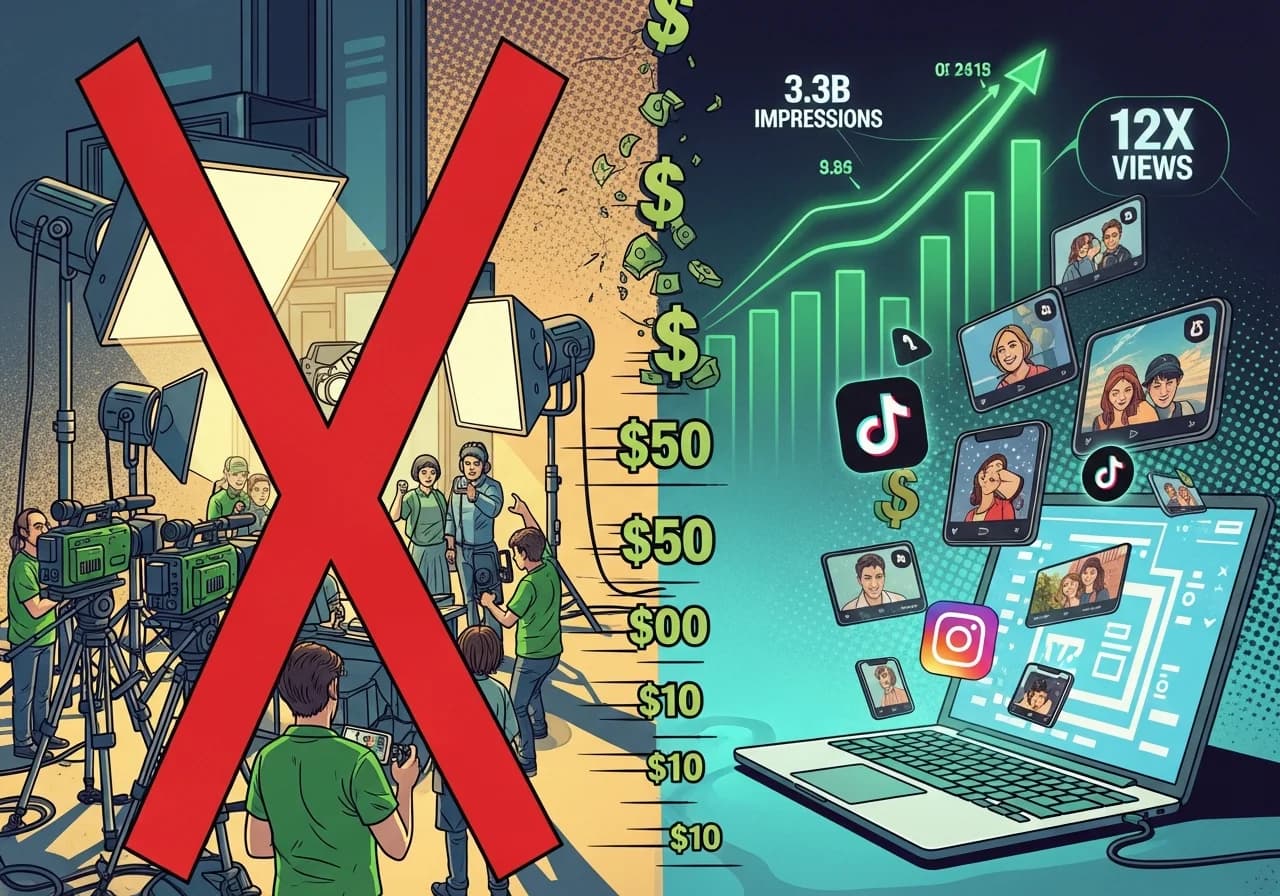
In the first half of 2025, brands using AI-generated UGC-style content have seen results that traditional advertising simply can't match: 3.3 billion impressions, 12x increases in organic views, and production costs dropping by 97%. The shift isn't coming. It's already here.
This matters because while you're debating whether to hire another influencer at $500 per video, your competitors are pumping out hundreds of authentic-looking UGC videos for under $10 each. The brands winning in 2025 aren't the ones with the biggest budgets. They're the ones who figured out that AI can create content that feels human without the human price tag.
What makes UGC AI videos different from everything else
UGC AI videos combine two powerful forces: the trust-building authenticity of user-generated content with the speed and scale of artificial intelligence. These aren't the robotic, obviously fake videos you might imagine. Modern AI tools create content that mimics the casual, phone-shot aesthetic that performs best on social platforms, complete with natural speech patterns, realistic lip-sync, and that slightly imperfect quality that screams "real person."
The psychology is simple. According to industry research from Amra & Elma, 92% of consumers trust recommendations from people over brand advertising. When content looks like it came from an everyday user rather than a corporate marketing team, viewers drop their defenses. They engage instead of scroll. The twist? AI can now produce this authentic-feeling content faster and cheaper than actual humans.
Traditional UGC requires finding creators, negotiating rates, managing revisions, and hoping the final product matches your vision. AI UGC flips this model entirely. You control the script, the avatar, the tone. Everything. And you can generate hundreds of variations to test in the time it takes to brief a single creator.
The numbers back this up. According to Whop's 2025 UGC statistics, UGC-style content achieves 4x higher click-through rates and 50% lower cost-per-click compared to traditional brand ads. On TikTok specifically, UGC is the best-performing content type at 56%, surpassing standard ads by 46% in engagement. These aren't marginal improvements. They're fundamental shifts in what works, as covered in how to make viral AI videos in 2026.
Headway turned AI into 3.3 billion impressions
Ukrainian edtech startup Headway provides the clearest proof that AI UGC isn't just viable—it's dominant. The company behind micro-learning apps with over 50 million users across 140 countries made a strategic decision in 2024: every UGC-style video ad would be produced using AI technology.
Their toolkit includes HeyGen for AI avatars and lip-sync, Rask AI for translation, and MidJourney and Leonardo AI for imagery. The approach paid off spectacularly. According to Business Insider reporting, in the first six months of 2024 alone, Headway's AI-powered campaigns generated 3.3 billion ad impressions—a number that would be unattainable with traditional creator content at any reasonable budget.
The ROI story is equally compelling. Video ad performance increased by 40% while production costs dropped significantly. UGC-style ads now account for 30-50% of all subscription purchases and free trial signups for the company. One in five paid downloads comes directly from AI-generated static images.
What makes Headway's approach particularly clever is their multilingual strategy. When expanding into the French market, they used AI tools to translate English-speaking creator footage into convincing French ads with AI voiceover and lip-sync. The videos look native to French audiences despite originating from English content. This kind of localization at scale would be prohibitively expensive with traditional production methods.
The content itself is designed to blend seamlessly into TikTok and YouTube Shorts feeds. Vertical format, casual delivery, the slightly unpolished aesthetic that signals "real user" rather than "paid ad." Viewers engage because the content doesn't trigger their ad-avoidance instincts, similar to strategies discussed in hooks and pattern interrupts that drive viral openers.
Imalent proved the math works for consumer brands too
If Headway represents AI UGC at scale, flashlight manufacturer Imalent proves it works for smaller consumer brands with tighter budgets. In February 2024, the company partnered with Creatify AI to generate TikTok content—and the results reshaped their entire marketing approach.
Before AI: Imalent was producing UGC-style videos at $150-$1,000 per video, working with creators and managing traditional production workflows. Organic videos averaged around 13,900 views each. After implementing AI-generated UGC: production costs dropped to approximately $4 per video—a 97% reduction—while organic views jumped to 170,300 per video, a 12x increase.
The cascade of improvements went beyond views. Likes quadrupled. Comments doubled. Saves increased by 700%. Paid performance followed organic success, with paid views doubling without any increase in ad spend. This isn't incremental optimization; it's a complete transformation of marketing economics.
The videos themselves feature AI avatars delivering scripts in conversational, first-person style. "I finally found the perfect flashlight..." opens one ad, immediately establishing the user testimonial framing that drives trust. Production quality intentionally mimics smartphone footage with natural lighting and casual delivery. The goal isn't to look expensive—it's to look authentic.
Imalent's case demonstrates that AI UGC isn't just for venture-backed tech companies with massive budgets. A flashlight brand achieved these results, which suggests the opportunity extends across virtually every consumer product category. The limiting factor isn't technology—it's adoption. For more on how different brands are using AI to promote their products, the opportunities span every vertical.
Zumper scaled to 300 videos monthly with one editor
Rental marketplace Zumper represents the SaaS application of AI UGC—and perhaps the most dramatic demonstration of production efficiency gains. With 76 million annual site visits and backing from Kleiner Perkins and Blackstone, Zumper needed content at scale. According to their Creatify case study, their solution was integrating Creatify's API directly into their workflow to produce UGC-style social videos for landlords.
The output is staggering. Zumper now produces over 300 videos per month (some reports cite 1,000+ video ads monthly), all managed by a single editor. Monthly savings: approximately $20,000 in content creation costs. The company eliminated the need for agencies, external creators, and full creative teams for social video production.
The content itself serves a specific purpose: helping landlords promote rental listings on TikTok, Instagram, and other social platforms. AI avatars deliver property information in a casual, first-person style that mimics organic real estate content. "Check out this amazing apartment in..." sets up a walkthrough that feels like a friend sharing a discovery rather than a corporate advertisement.
This use case illustrates AI UGC's B2B potential. Zumper isn't just producing content for their own marketing—they're enabling their customers (landlords) to create professional-looking promotional content that would otherwise require significant investment. The platform becomes more valuable because it solves a content creation problem that previously had no cost-effective solution.
For SaaS companies specifically, Zumper's approach offers a template. If your platform serves users who need content—whether for marketing, sales, education, or communication—AI UGC capabilities can become a product feature rather than just a marketing tool, as explored in AI videos formats driving crazy engagement.
The psychology explains why this actually works
The counterintuitive success of AI-generated "authentic" content makes sense once you understand the underlying psychology. Consumer behavior research consistently shows that trust transfers from the perceived creator to the product. When an ad looks like it came from someone relatable—regardless of whether that person actually exists—viewers apply the same trust heuristics they would to a genuine recommendation.
Social proof theory, popularized by psychologist Robert Cialdini, explains part of the mechanism. When consumers see others using a product, they perceive it more favorably. The key insight: the "others" don't need to be real—they need to be believable. AI avatars designed to look and sound like everyday users trigger the same psychological response as actual user content.
The data supports this. According to Stack Influence's research, 79% of people say UGC highly impacts their purchasing decisions. EveryoneSocial reports that 60% of consumers believe UGC is the most authentic form of content. UGC-based content is 5x more likely to convert shoppers than traditional advertising. These numbers don't distinguish between real UGC and AI UGC that achieves the same authentic feel—because from the consumer's perspective, the experience is identical.
Lo-fi content specifically outperforms polished production by significant margins. Research from Shuttlerock found that lo-fi videos outperform polished ones by nearly 2x in engagement rates. When audiences scroll through feeds dominated by organic, user-created content, a highly polished ad sticks out—and triggers immediate ad-avoidance behavior. Content that matches the aesthetic of what users expect to see gets engagement that corporate-looking content cannot.
The cost revolution changes everything for marketers
Traditional UGC creator rates in 2025 average $150-$300 per video for mid-level creators, with established creators charging $500 or more, according to Influee's comprehensive rate guide. Platform-specific rates vary: Influencer Hero reports TikTok videos typically run $30-$250, Instagram content $50-$500+, YouTube long-form $200-$1,000+. Factor in revisions, project management, and content that doesn't perform, and effective costs climb higher.
AI UGC platforms have collapsed these economics. Tools like Reshort generate authentic-looking UGC-style videos for a fraction of traditional costs—often under $10 per video. The math is straightforward: if traditional creators charge $200 per video and AI tools deliver comparable performance at $10 per video, you can produce 20x more content variations for the same budget. More variations mean more testing opportunities, which drives performance optimization that further improves ROI.
The efficiency gains extend beyond direct cost savings. AI platforms generate content in minutes rather than the days or weeks required for traditional creator workflows. This speed enables rapid campaign iteration—launching tests, analyzing performance, and scaling winners within timeframes that would be impossible with human creator dependencies.
Brands report savings of 50-80% when switching from traditional creator content to AI UGC. Combined with performance improvements from increased testing velocity, the total impact often exceeds simple cost calculations. The question for marketers isn't whether AI UGC is cheaper—it's whether continuing with traditional approaches remains defensible.
How to create AI UGC that actually converts
Start with scripts written for conversation, not presentation. AI UGC fails when it sounds like marketing copy delivered by an avatar. The content that works reads like someone talking to a friend: short sentences, natural pauses, casual vocabulary. Scripts should open with hooks that stop the scroll—questions, surprising statements, or relatable problems. For deeper insight on attention-grabbing openings, explore proven hooks and pattern interrupts that drive engagement.
Platform selection matters enormously for AI UGC success. According to Enhencer's 2025 analysis, TikTok currently delivers the highest engagement rates for UGC-style content at 4.86%, with YouTube Shorts close behind at 5.91%. Instagram Reels offer strong conversion rates—1.3x higher than other formats for e-commerce. Match your AI UGC strategy to the platforms where your audience engages and where the content format performs best.
Testing volume separates successful AI UGC campaigns from unsuccessful ones. The production economics that make AI UGC attractive also enable testing approaches that were previously impractical. Generate multiple avatar variations, test different hooks, experiment with lengths and calls-to-action. One of AI UGC's key advantages is the ability to run dozens of variations simultaneously rather than betting on single pieces of content.
Visual style choices significantly impact performance. The goal is blending with organic content, not standing out with production quality. Vertical format is mandatory for TikTok and Reels. Lighting should look natural rather than professional. Backgrounds should suggest real environments rather than studios. For detailed guidance on which aesthetics drive results, check out the best visual styles for AI videos.
Tools like Reshort simplify this process by generating UGC-style videos optimized for social performance in a single click. Rather than managing multiple platforms and workflows, you can produce scroll-stopping content designed to convert—without the technical complexity that traditionally accompanies video production.
The future belongs to brands that adapt now
The AI UGC market is growing at 19-33% annually, according to CoSchedule's State of AI in Marketing Report, with the broader AI content creation market projected to reach $80 billion by 2030. Synthesia's 2025 research shows more than 85% of marketers are already leveraging AI content creation tools in some capacity. 56% of marketers now claim AI-generated content outperforms human-created content in their campaigns.
Regulatory changes are coming. China's AI content labeling rules take effect in September 2025, requiring explicit disclosure of AI-generated content. The EU AI Act will mandate similar transparency by 2026. US FTC rules already prohibit deceptive synthetic content. Smart brands are building disclosure practices into their AI UGC strategies now rather than scrambling to comply later.
The authenticity paradox—AI creating "authentic" content—will intensify as consumers become more aware. The brands that navigate this successfully will treat AI as a collaborator rather than a replacement for human creativity. According to inBeat Agency's analysis, hybrid approaches that combine AI efficiency with genuine human oversight consistently outperform fully automated or fully human content strategies.
For marketers still on the sidelines, the evidence from Headway, Imalent, and Zumper provides clear direction. AI UGC isn't experimental anymore—it's producing billions of impressions, 12x view increases, and 97% cost reductions for brands across categories. The tools are accessible. The economics are favorable. The only remaining question is execution.
Ready to create AI videos that sell? Explore how to promote your brand with AI for strategic guidance, or discover video formats driving engagement to maximize performance. For creators looking to monetize, check out how to make money with AI videos in 2026. The shift to AI UGC is happening now—and the brands moving fastest are capturing advantages that late adopters will struggle to match.
Conclusion
UGC AI videos have crossed from novelty to necessity in 2025. The three examples examined—Headway's 3.3 billion impressions, Imalent's 12x organic view increase, and Zumper's 300+ monthly videos from a single editor—demonstrate that AI-generated content matching the authentic UGC aesthetic now delivers results that traditional approaches cannot match at comparable costs.
The winning formula combines psychological insight (consumers trust content that looks user-generated) with economic reality (AI production costs are 90%+ lower than traditional creator content) and testing velocity (more variations equal faster optimization). Platforms like Reshort make this accessible to brands of any size, removing the technical barriers that previously limited AI video adoption.
The competitive window for early adoption won't remain open indefinitely. As AI UGC becomes standard practice, the advantage shifts from "using it" to "using it best." Brands starting now accumulate testing data, refine their approaches, and build capabilities that become increasingly valuable as the space matures. The question isn't whether AI UGC works—the data proves it does. The question is whether you'll be among the brands capturing that value or competing against those who already have.